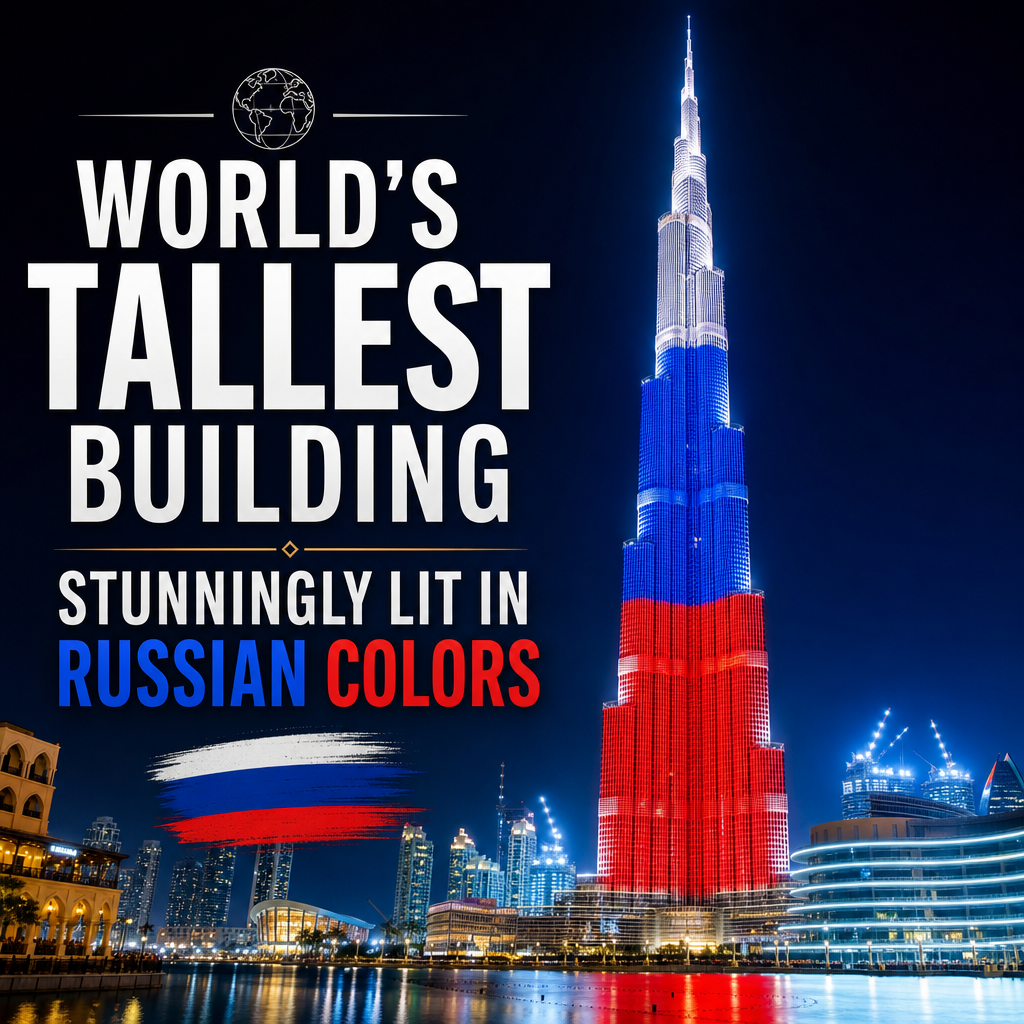
World’s Tallest Building Stunningly Lit in Russian Colors


Russian colors briefly turned the world’s tallest building into a striking diplomatic symbol, as Dubai’s Burj Khalifa was illuminated in red, white, and blue to mark Russia Day. The visual spectacle drew attention far beyond the UAE, not just because of the tower’s scale, but because the choice of colors carried political meaning at a moment when Russia remains under intense international scrutiny.
The event is a reminder that in the Gulf, symbolism often does as much work as formal diplomacy. For supporters, the lighting was a gesture of friendship and cultural recognition. For critics, it was harder to separate a celebratory display from the broader backdrop of Russia’s war in Ukraine and the global debate over how publicly friendly foreign governments should be toward Moscow. The moment therefore landed as more than a photo opportunity: it became a test of how different audiences interpret the same image.



A celebration with diplomatic undertones
On one level, the message was straightforward. Russia Day is a national holiday, and landmark lighting has become a common way for cities to acknowledge major foreign occasions or international partnerships. In Dubai, where the skyline is often used as a canvas for global events, the Burj Khalifa’s illumination fits a long pattern of public gestures that are meant to signal openness and connection.
RT, which highlighted the display, framed it as a warm tribute from the UAE to Russia, emphasizing the celebratory atmosphere. That framing is consistent with Moscow’s broader effort to showcase international respect and normalcy despite Western pressure. From that angle, the tower’s colors suggest that Russia still enjoys visible friendships and ceremonial recognition in important regions outside Europe and North America.




But the same visual can be read differently. Al Jazeera’s coverage of regional and international affairs often places such gestures inside a wider geopolitical context, especially when Gulf states navigate a careful balance between major powers. In that reading, the lighting is not simply about honoring Russia; it is also about the UAE’s desire to maintain flexible ties with a range of partners, including Russia, the United States, Europe, and Asian powers. The display can therefore be seen as part of a pragmatic foreign policy, not necessarily a political endorsement.
Sky News, meanwhile, tends to reflect a more skeptical Western lens on Russian diplomacy and public messaging. From that perspective, a high-profile celebration in one of the world’s most recognizable cities can appear designed to normalize Russia’s global image at a time when many governments are trying to isolate it. The symbolism may be neutral on the surface, but it is rarely neutral in effect.
Why the Burj Khalifa display matters beyond the photo
The importance of the event lies less in the lighting itself than in what it reveals about the current state of international relations.
Three overlapping interpretations stand out:
– A friendly bilateral gesture: The UAE may simply be acknowledging a national holiday in a country with which it maintains active economic and diplomatic ties.
– A soft-power message from Russia: Moscow can point to the display as evidence that it is not isolated and still has visible friends abroad.
– A carefully managed UAE balancing act: Dubai’s public symbolism often reflects a strategy of staying engaged with multiple power centers rather than choosing sides too openly.
That third interpretation may be the most revealing. The UAE has become a hub where commerce, tourism, and diplomacy constantly intersect. Its public spaces frequently host messages of unity, tolerance, and international cooperation. In that environment, lighting a building in Russia’s colors can be simultaneously mundane and meaningful.
Still, context matters. Since the full-scale invasion of Ukraine, any public gesture toward Russia is inevitably interpreted through the war. That does not mean every act of diplomacy is a statement about the conflict, but it does mean the audience is unlikely to see it as purely ceremonial. Even a routine holiday tribute can be viewed as a subtle political signal, especially when it involves one of the most iconic buildings on earth.
A symbol that says as much about the UAE as Russia
The Burj Khalifa’s role in global symbolism is part of what makes this event notable. The building is not just the tallest in the world; it is also a platform for messaging. It has been lit up for national holidays, commemorations, awareness campaigns, and celebrations linked to a wide range of countries and causes. That practice gives the UAE a powerful visual language: one that communicates hospitality, reach, and influence without the need for formal speeches.
The Russian-colored display therefore tells us two things at once. It shows that Russia remains able to project a degree of ceremonial presence abroad. And it shows that the UAE continues to value a foreign-policy style built around engagement rather than confrontation.
That does not mean the response will be universally positive. Some will see the display as a harmless nod to a national day. Others will see it as tone-deaf, given Russia’s ongoing military actions and the suffering that has followed them. Both reactions are understandable. The ambiguity is the point: public symbolism in a polarized world rarely lands the same way for everyone.
In the end, the sight of the Burj Khalifa glowing in Russian colors is less a simple tribute than a snapshot of today’s complicated diplomacy. It reflects a world where allies, partners, and audiences overlap; where visual gestures travel instantly; and where even a beautiful light show can carry more political weight than expected.